
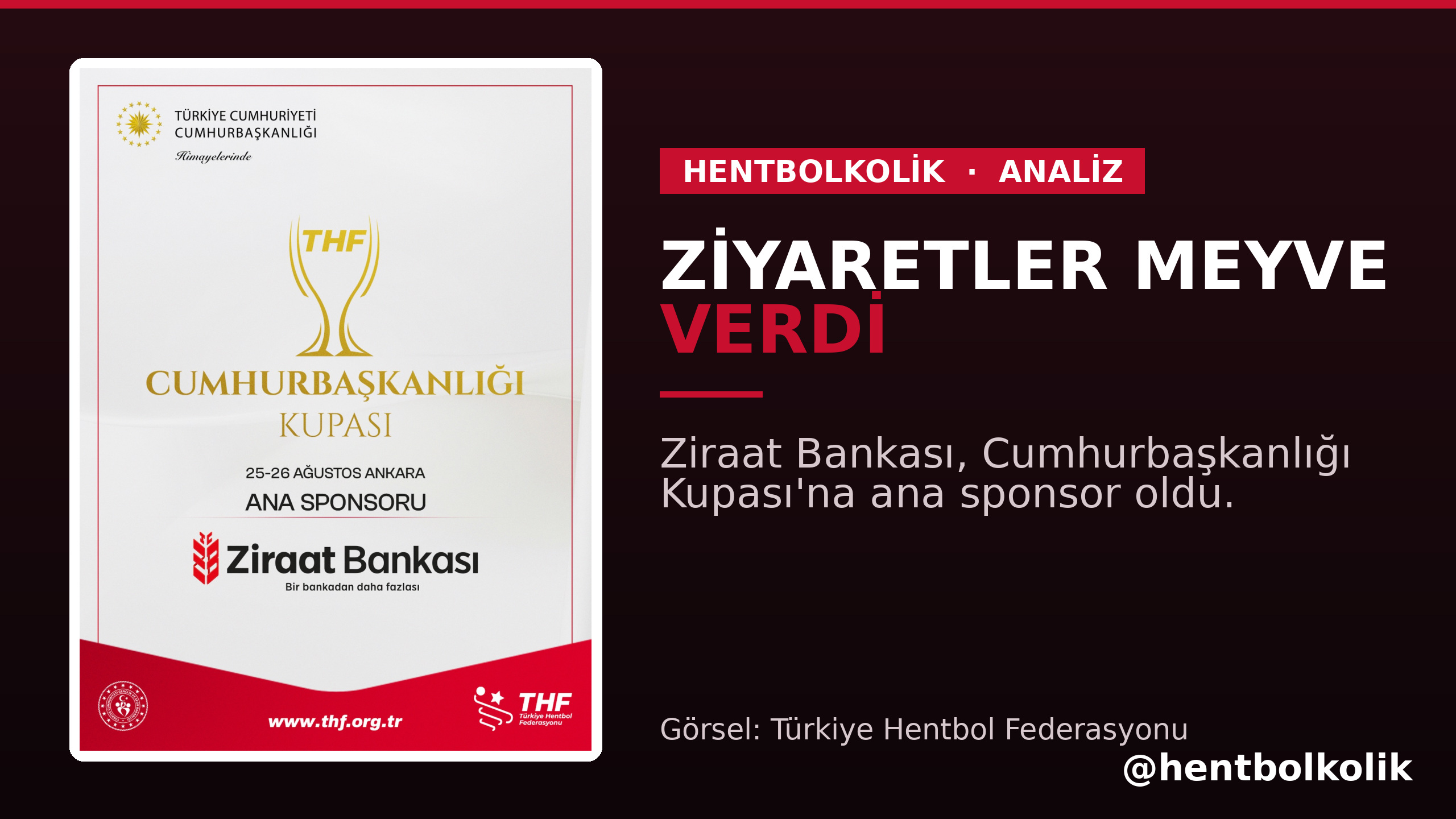
Turkish handball is getting its first-ever Presidential Cup. Set to be held on August 25-26 at the Prof. Dr. Yaşar Sevim Handball Hall in Ankara, the tournament — featuring eight teams each in the women's and men's competitions — will take place under the patronage of the Presidency. With the federation's announcement, the main sponsor of the organisation has also been confirmed: Ziraat Bankası.
This sponsorship did not materialise overnight. Turkish Handball Federation (THF) President Mesut Çebi has recently knocked on a series of high-level doors in succession, discussing the future of Turkish handball with Ziraat Bankası Chairman of the Board Abdullah Erdem Cantimur and VakıfBank General Manager Osman Arslan, presenting each with a national team jersey. Ziraat Bankası's move to become main sponsor of the Presidential Cup is the first tangible fruit of this round of meetings.
A federation president personally knocking on the doors of bank management to seek sponsorship is not a familiar reflex in Turkish handball. Federations have traditionally tended to make do with existing resources; what sets the Çebi administration apart is precisely this proactive approach of reaching out to corporate capital. Before results on the court, it is about tackling the issue at its true source — the revenue side.
Yet relationships of this kind do not mature in a single season. Some visits require patience before bearing fruit; not every meeting immediately turns into a signed agreement. But the direction is clear: a prestigious Presidential Cup backed by a powerful bank sponsor makes handball visible in the eyes of corporate investors. The expectation is that this momentum will not remain confined to the cup but will, over time, extend positively to league organisations as well.
Revenue has always been Turkish handball's most chronic problem; what is new is a federation trying to solve that problem not only on the court but also at the negotiating table. The Presidential Cup is the showcase of this strategy; the real test is whether the same interest will trickle down to the league and the clubs after the cup. For now, the first brick appears to have been laid.
Visits Start to Bear Fruit: Ziraat Bankası Becomes Main Sponsor of the Presidential Cup
The high-level visits paid by Turkish Handball Federation (THF) President Mesut Çebi to major banks have produced their first concrete result: Ziraat Bankası has become the main sponsor of the Presidential Cup, the first tournament of its kind in Turkish handball. But the real story is bigger than a single tournament.
In This Story
- Ziraat Bankası has become the main sponsor of the Presidential Cup (August 25-26, Ankara), the first tournament of its kind in Turkish handball, featuring eight teams each in the women's and men's competitions.
- The sponsorship is the first concrete fruit of the high-level visits THF President Mesut Çebi paid to the management of Ziraat Bankası and VakıfBank; a federation president personally pursuing capital investment is not the norm in Turkish handball.
- Such relationships require patience; the expectation is that the momentum generated by the prestigious cup and the bank sponsorship will eventually extend to league organisations and clubs as well.
In Turkish handball, federations have traditionally made do with state support and available resources; a president personally chasing capital investment is a rare sight. What Çebi has done is tackle the problem exactly where it needs to be tackled — on the revenue side. Ziraat Bankası's sponsorship alone will not revive the league; but it is a meaningful signal that handball is now being discussed at the corporate table. The real value lies not here but afterward — in whether these relationships trickle down to the league and clubs after the cup. It's a gamble that demands patience, but the right one to make.
