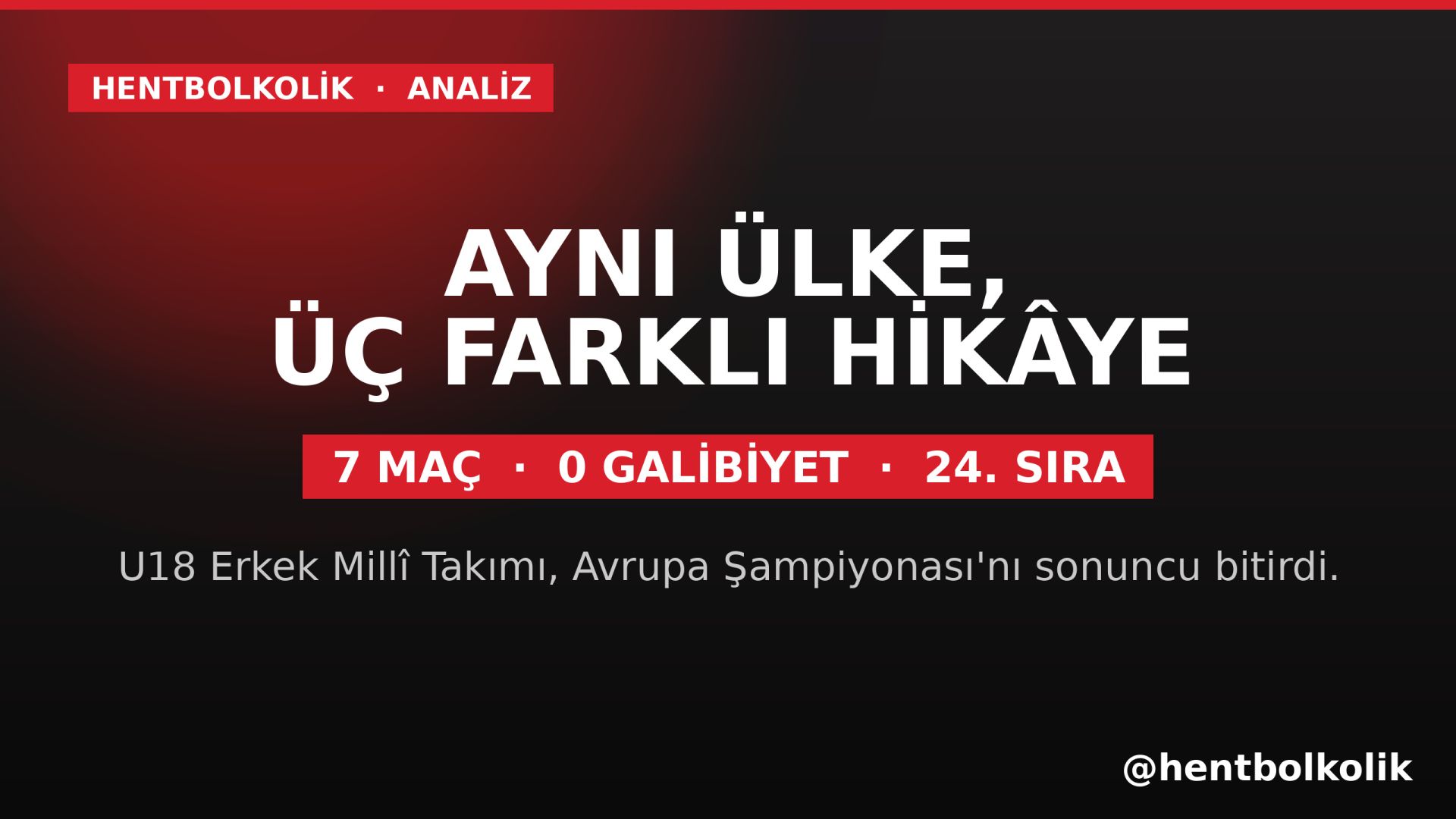
The Men's U18 European Championship concluded in Serbia. Germany claimed the trophy, with Slovenia finishing second and Denmark third. Turkey's U18 National Team, meanwhile, lost all seven of its matches to finish the tournament in 24th and last place. The scoreline looks harsh — but the real story runs a little deeper than that table suggests.
In the group stage, the Turkish side went winless in Group B, losing 34-25 to hosts Serbia, 41-23 to Italy, and 45-23 to the tournament's new champions, Germany. The picture shifted in the placement round: after a loss to Sweden, Turkey fell 29-27 to North Macedonia, 39-32 to Switzerland, and 28-26 to Montenegro in the closing match. While the gaps widened against Europe's elite sides, matches against teams closer to Turkey's own level came down to margins as small as two goals. That distinction matters: the issue isn't a lack of effort or desire, but the experience gap against the very top teams.
At the root of that gap lies a single fact: Turkish handball has not yet built a tournament habit. One need not look far to understand why — the senior Men's National Team will make its first-ever World Championship appearance in 2027 and has never once qualified for a European Championship. It would be unrealistic to expect ready-made tournament maturity from 18-year-olds in a country whose elite team has only just become acquainted with major tournaments. A tournament culture is still being born in this country.
There are examples within the same country of how this culture can be built — just in other sports. Turkish basketball has produced European titles at youth level: gold medals at U16 in 2005 and 2012, and in 2013 the Junior National Team's first-ever European title. Women's volleyball's "Young Sultans" have become almost permanent fixtures on the European podium in recent years, winning gold at the 2024 U20 European Championship. These successes are no coincidence: in both sports, the youth national teams were run largely by the same coaching staffs and squads that maintained continuity. As the technical staff and system stayed in place year after year, a playing model took root and one generation fed into the next.
In handball, it is precisely that continuity that is missing. When the system and coaching staff change frequently, neither a playing model can take root nor can tournament experience be passed down to the next generation; each new setup starts from scratch instead of building on what came before. What carried basketball and volleyball to the podium wasn't extra talent — it was preserved memory and a stable foundation. For handball to climb above 24th place, it will depend on that same foundation: continuity.
And culture, by definition, is built through repetition. One tournament teaches; ten tournaments create a habit. If this U18 generation is kept together, continues to take the field year after year under the same coaching philosophy, and is repeatedly exposed to the tempo of big matches, the games lost by two goals today will start to be won tomorrow. Today's 24th-place finish isn't a verdict — it's a starting snapshot, and its value will be measured by what follows.
So what comes next? This tournament in Serbia also served as qualification for the 2027 U19 World Championship; the top 14 teams secured their World Championship berths, and Turkey, finishing 24th, missed out. The next U18 European Championship will be held in 2028 — but with an entirely new generation, as this year's players will have aged out of the category. Nor is qualification for that championship guaranteed: every cycle requires passing through qualifying tournaments, with the alternative being relegation to the lower-tier Championship division. This is exactly where the real test of continuity begins: when the new generation takes the field, the only bridge capable of carrying today's accumulated experience forward to them is a coaching staff that stays in place and a system that has taken root. If that bridge isn't built, the 2028 generation will start from the very same point — from scratch.
Germany didn't lift this trophy by accident; behind it lies decades of tournament experience, an uninterrupted development pipeline, and a big-match culture that has become second nature. Turkey is only at the beginning of that road. Seven defeats may be discouraging, but the real question isn't about the final standing: Can we give this generation the continuity needed to turn their experience into a habit? If the answer is yes, this tournament will be remembered not as a disappointment, but as the first brick laid.
Tournament Habits Aren't Built in a Day: The Real Lesson from the U18 National Team
The Men's U18 European Championship has concluded, with Germany lifting the trophy. Turkey's U18 National Team lost all seven of its matches and finished 24th. But the real story isn't found in the standings.
In This Story
- At the Men's U18 European Championship, Germany won the title, Slovenia finished second and Denmark third, while Turkey's U18 National Team lost all seven matches to finish 24th and last.
- While basketball (U16 European titles in 2005/2012 and the Junior National Team's title in 2013) and volleyball (the "Young Sultans," including 2024 U20 European gold) have built continuity and produced titles at youth level, handball has not — because th
- Turkish handball has not yet built a tournament habit (the senior men's team will make its first World Championship appearance in 2027); the only remedy for establishing this culture is continuity — keeping this generation together and exposing them to to
While basketball and volleyball have produced European titles at youth level in the same country, handball's 24th-place finish is not a matter of talent but of continuity. Those sports preserved their coaching staffs and systems for years; the system took root, and generations fed into one another. In handball, because every restructuring starts from scratch, neither a playing model takes root nor does experience accumulate. What will determine this U18 generation's future is not the talent on the court, but whether there will be the continuity to keep them together year after year under the same coaching philosophy. In handball, permanence is the championship most urgently needed.